Dec. 2019
Spider wore jeans, the raw denim kind. Black leather straps buckled around each ankle kept the hem of his pants from jamming up his chain. Duct tape wrapped around the wrists of his jacket prevented the wind from whooshing in. His thumb and pointer finger peeped through the frayed tips of his black polyester gloves. “The main thing is to keep your neck warm,” Spider said. It was a cold November morning, and the bicycle messenger was about to spend another day traversing Manhattan’s streets.
Born Michael Rojas, the tag “Spider” stems from the days when he used to cling onto the back fender of trucks “like a spider,” whizzing around his delivery route. At 56-years-old, Rojas doesn’t dare ride like that anymore. But he’s held onto the nickname. “I’m the last of the dinosaurs,” Rojas said, his cheeks rosy from years of bike-induced windburn. A five-o’clock shadow added more texture to his already weathered face.
Rojas operates in the “paperwork” domain: packages, garment bags, envelopes. The requests he receives come through MobileTek Boost, an app on his company-owned white Samsung cell phone that dispatches client addresses and contact information. Regular deliveries include Ralph Lauren, Michael Kors, and Stuart Weitzman. Rojas rattles these names off with ease as if he knows the fashion designers personally. He remembered recently delivering a diamond-encrusted pair of Jimmy Choo sneakers to the doorman of an apartment building. It’s unusual for Rojas to encounter his actual client.

A separate, less flashy task: pick up an umbrella from an apartment (via the doorman) and deliver it to a customer at Willkie Farr & Gallagher, a corporate law firm on 7th Avenue. “That’s a stupid fucking delivery, wouldn’t you think? I’m like, this is a guy asking for an umbrella?” Rojas said. He was paid less than $10 for the delivery.
One of an estimated 1,500 traditional New York City bicycle messengers, Rojas is one of the oldest on the job. The estimate of couriers, according to one NYC based messenger company called Samurai, is an admittedly rough one. “If you include the gig economy or part-time market and food delivery, who knows? 5,000? 10,000? 20,000? I mean, name a neighborhood in NYC where you don’t see a few dozen people delivering dinner by bicycle every night,” said Joshua Weitzner, co-founder of Samurai. Given the number of operators, the variety of contracts, and a patchwork of regulations, numbers on the profession can be elusive.
With over three decades of professional messenger experience in New York City, Rojas has seen the job evolve. He said he makes about half of what he used to when he started out in 1985, when a cousin introduced him to the job. Back then that meant up to $1,300 a week before taxes. Now, he averages closer to $600. But it’s a really bad week when he can’t pull in $500 through his commission-based delivery job with Select Express & Logistics, a New York City delivery service founded in 2001.
For a 56-year-old to do this kind of physically demanding work day after day, he has to love it. Or need it. “I’ve been trying to get out of the job for 10 years,” Rojas said. “This is the worst. We’re at the bottom of the crop.” He rattled off more annoyances: “I’ve been hit twice, I’ve had a broken hand. I risk my life out there for fucking peanuts.”
He delivered these hard complaints with a grin, crooked teeth peeking through cracked lips, while energetically pouncing across the pavement. The overall effect was a softening one. Crusty grandpa meets schoolyard boy. Rojas sticks with the job because his criminal record makes it difficult for him to find work elsewhere. He has felonies on his record for a pattern of “sneaky hands” that he said lifted things like a laptop computer from a CitiBank office in midtown, and Dell monitors from Columbia University computer labs.
Rojas made these thefts while working as a messenger, using a delivery as his foot in the door to make off with electronics to sell for extra cash. For Rojas, recognition of these acts are less whispered confession and more shrug of the shoulders. He said he had an ethical code. He’d only take things from “corporates” and not individuals. “All those flat screens, Columbia’s paying for it,” Rojas said. “I never pull out guns, I never pull out knives. I don’t hurt nobody. That’s the deal.”
But the judge who sentenced Rojas was unimpressed by that distinction. In 2006, Rojas spent seven months at Rikers Island jail in New York City, and then seven more months at Riverview Correctional Facility, a medium-security prison in upstate New York less than five miles from the Canadian border.
The next few years were a cycle of catch-and-release: Rojas was sent back to Rikers Island twice more. He had trouble finding a company that would hire him and look past his criminal record. He said Select was the only company that would take a chance on him while he was on parole.
Most weekday mornings, the hardworking father of three can be found on the southeast corner of 54th Street and Park Avenue, where he waits for his first request of the day to ping his phone. Though he commutes from the last stop on the F train in Jamaica, Queens and doesn’t start riding until 9:00 a.m., he arrives at the midtown Manhattan corner by 7:00 a.m. each morning.
He is usually the first messenger to get there, and over the course of the next two hours he will smoke at least two cigarettes, watch videos on his phone (“Little Rascals” is a favorite), and catch up with other morning regulars like the two men who operate the corner coffee cart. On the coldest mornings, Rojas burrows into a battered white delivery van parked on the northside of the street. The van belongs to the men who run the coffee cart, and they share that waiting space along with any leftover mismatched sandwiches with Rojas in exchange for his lively conversation and an occasional delivery errand.
With his more than 30 years biking through New York, Rojas has seen the city’s streets change. Since he started working as a messenger in 1985, bike ridership in New York City has increased by over 450 percent, according to city transportation data. The mid-1980s marked the height of the city’s messenger culture, according to Evan Friss, author of a book on the history of cycling in New York City.
Today, the city estimates the number of daily bike trips are just under half a million. To cope with the increase, last fall Mayor Bill de Blasio backed a $1.7 billion plan to improve biking conditions. Rojas thinks the cement barriers that have been put in place to slow city drivers and protect bikers are dangerous obstacles so he chooses to ride in the streets instead, often against the flow of traffic and through red traffic lights. Speed is an important variable in his job. The more deliveries he makes, the higher his paycheck. This biking behavior is at odds with New York City policy, which strives to make riding safer for more people.
Last year, there were at least 28 cyclist deaths in New York City, according to the New York Police Department. Two of those killed were bike messengers. Aurilla Lawrence, 25, was killed in February while on her bike in Williamsburg and Robyn Hightman, 20, was killed in June while on her bike in Flatiron. Both collided with trucks.
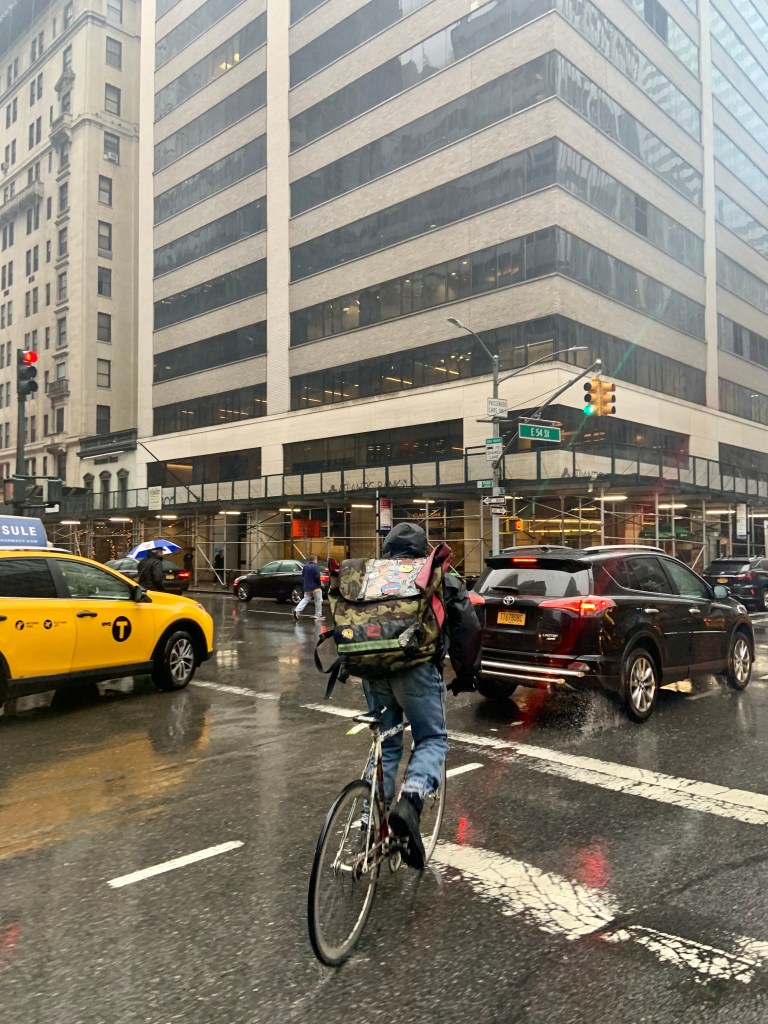
Despite the increased volume of cars, bikes, and danger on the streets of New York City, Rojas doesn’t wear a helmet. His ride, a fixed bike he named “Emily,” has a thin steel frame and is spattered with stickers: Smoke Local, WeWork, Emergency Brake. That last sticker – peeled off from the inside of a subway car – is misleading. Emily doesn’t have brakes. Rojas said he likes it better that way. “Less maintenance, a little more dangerous,” he calculated.
Aside from the collage of stickers, Emily is unassuming. There isn’t a bell or a basket or a light. Rojas proudly showed off a jerry-rigged fender covering the back wheel, which prevented mud from spraying onto his back when it rained. Depending on the delivery, Rojas locks up his bike to a nearby bicycle-rack or wheels it inside.
He’s against the idea of riding a cargo-bike or an electric-bike, which could potentially help him carry a heavier load or travel longer distances. He called a passing Whole Foods cargo bike a “caterpillar” and said the clunkiness would make his work more dangerous. Instead, he chooses to ride only with a waterproof black backpack strapped to his back.
Rojas said his work as a courier barely covers the bills. “I’m a check to check person,” he said. He told his landlord he’d be late on rent for December and January. As a tenant in the same building for over 20 years, he trusts his lapse in payments are understood. He shares his Jamaica-Hollis, Queens, apartment with his mother, his wife Penny (who he said he isn’t legally married to) and his youngest daughter, Jamie, who is 13-years-old. His two older daughters have kids of their own and don’t live with him anymore.
The most visible businesses near Rojas’s current apartment are storage facilities and auto-repair shops that alternate with each other up and down Jamaica Avenue. “It kind of sucks over here,” Rojas complained. Rojas wants to move to another neighborhood in the city where he can provide better opportunities for Jamie, who he said is struggling in school. Even a few blocks north closer to Cunningham Park would be better, where the streets are wider and there’s a slightly suburban feel.
One of four brothers, Rojas was raised by a New York City Police Officer father and housewife mother in Cypress Hills, Brooklyn and then Ozone Park, Queens. Rojas is a New York sports fan all around: Knicks, Rangers, Giants. He’s also a gambler, so with his Giants having a weak season, he bets on the opposing team. He’s a fanatic, but a realist. If Rojas could have any other job he would work as a landscaper, a profession he once tried out in his early 20s when he lived in Florida with his father. His father still lives there. Rojas recalls one homeowner gifting him fresh lobsters over the holidays. He said he would return to the sunshine state if he had the money.
Instead, on a rainy Monday morning in December, Rojas tried to strategize on how to keep a Ralph Lauren garment bag dry. He skipped waterproof clothes. The rain jacket and galoshes aren’t effective after eight hours in the rain. But he was still expected to protect the cardboard shoe boxes and paper shopping bags from the cascade of raindrops below the midtown skyscrapers. A positive, he noted, was that each day it rained, he got paid 15 dollars in cash for showing up to work. “Not bad,” he nodded in agreement with himself. He had considered staying home earlier that morning. The 15 dollars motivated him.
Mindful of his employment restrictions, Rojas contemplates moving over to Capsule, a startup that delivers prescription medications to its patients through an app. The height of the delivery season for Select has passed: December (holiday presents) and January (income tax forms) are two of the busiest months for the messenger business. Rojas prefers the summer months, but not because he prefers to ride in the warm weather. When it’s warm, he heads out to Rockaway Beach with his youngest daughter and his grandchildren. “We go boogie boarding all day,” he said with a grin, daydreaming of his favorite spot at 122nd Street. But summer days are far away, and Rojas has Stuart Weitzman boots to deliver and rent checks to assemble.
 Anmargaret Warner